
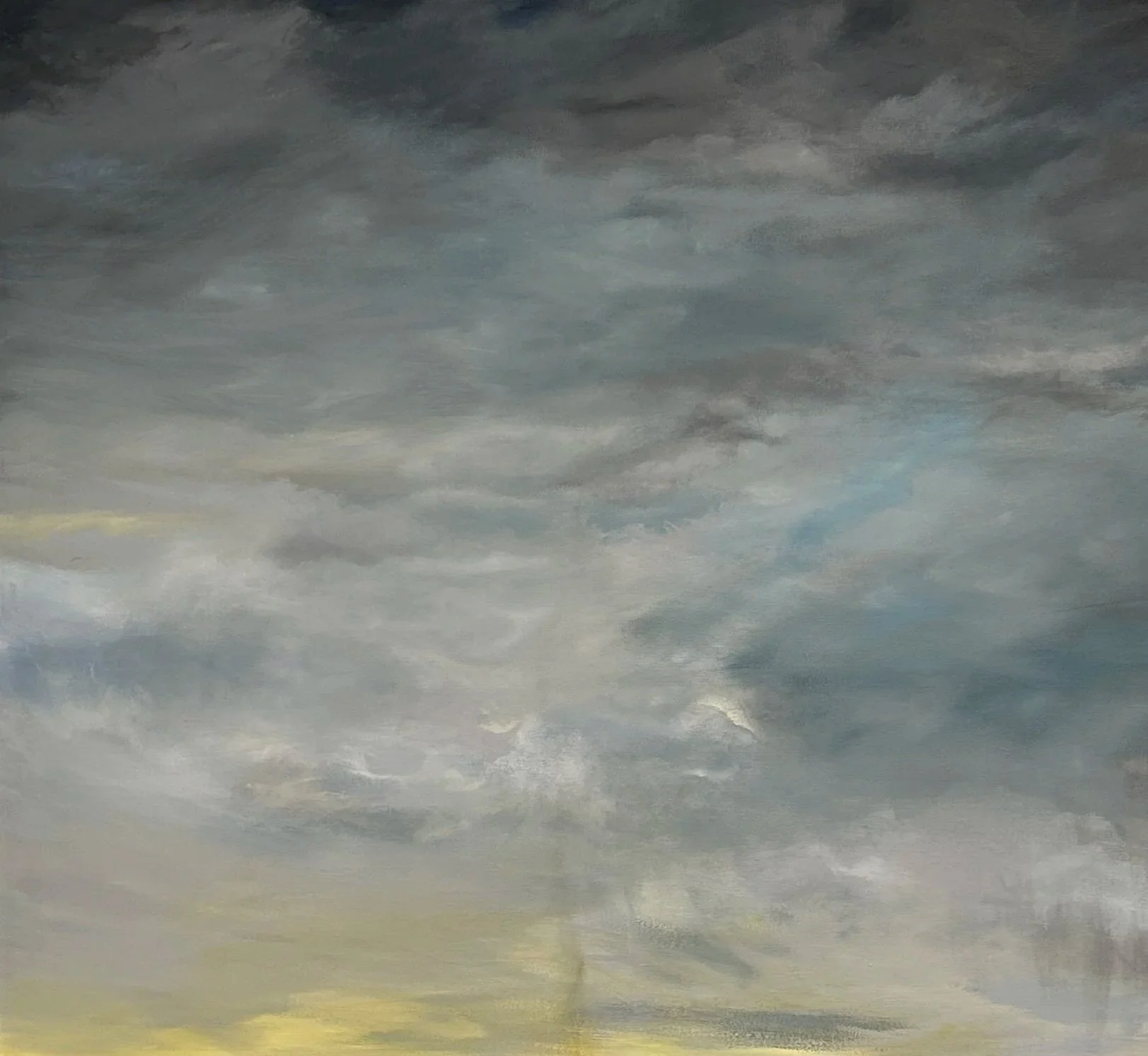
Sharon Singer’s ‘Strange Shores’
In response to Sharon’s work, independent art and cultural historian, critic, culture journalist and translator Andrew Paul Wood has written the below essay.
Sharon Singer paints as if the world were already a Cthulucene ruin and yet still capable of astonishment. She favours the landscape as fundamental stratum of her paintings, frequently flat and alluding to infinite horizons – aquatic, grassy plains, steppe. Is it a past we have forced ourselves to forget or a future that has not quite happened?
These landscapes are the domain of a diverse cast of surreal fairytale archetypes and folkloreish characters who passively observe the Ballardian invasion and transformation of their world. The pastorals of Andrew Wyeth and Grahame Sydney on an acid trip.
These invaders are often abstract blobs and growths, whose purpose seems to be to remind us that this is a painting rather than a fever dream, analogous to similar interventions in theotherwise figurative paintings of Sigmar Polke.
The paintings occupy that unstable zone where the real and the collectively imagined contaminate one another. Singer’s new works extend the trajectory of her 2021 exhibition Tales of the Anthropocene – Nightmares of a Better Tomorrow, but the stew of ecological dread, political absurdity, the gothic residue of late capitalism, has only thickened and grown more flavourful, more extreme.
Singer insists she is not cynical. She is right. Cynicism is a posture of resignation, and her work is animated by a stubborn, reckless and quite possibly delusional idealism. If Singer’s paintings are severe in their critique, even denial, of our present reality, it is because she refuses to lose hope and relinquish the possibility of a better future.
I like Singer’s vision better. Her visual language draws from fairy tales, magical realism, science fiction, the uncanny, the Fortean, the paranormal, the supernatural – haunted by potential asmuch as by ghosts. Her worlds are governed by a dream logic where the distinction between symbol and entity are blurred. Mutations abound. It is a therapeutic re-enchantment of theWorld.
Children appear a lot in the paintings, either innocent ritual-makers, or uncanny oracular emissaries from a parallel universe; animals are allegories observing; landscapes warp and buckle under the weight of their own lurid metaphors. Monstrosity is the most honest vocabulary for a species that has remade the planet in its own distorted image.
We are, as Singer says, living in Gothic times. Where in pop culture terms that is frequently a cliché or a Victorian aesthetic garnish, for Singer it is an important diagnostic tool for our times.Its tropes of spectrality, moral excess, and materialist apocalypse map neatly onto the ecological and political derangements of the present. It is a new mythology for a world grown sostrange that the old myths no longer function.
One of the most popular tropes of the Gothic is the haunted house. Singer offers us a haunted planet, a sentient Earth as a vast, wounded intelligence that, like the planet in Stanisław Lem’s Solaris, can only respond to human activity with fantastical constructs and facsimiles that defy interpretation. Humans are merely bystanders who can only acknowledge what is going on, but not react to it or change it.
Along with the Gothic, Singer deploys her other main instrument – ambiguity. The paintings refuse to settle into a single meaning. A scene that initially reads as playful can suddenly reveal a submerged moment of violent catastrophe that, nonetheless, contains a glimmer of renewal. Singer toys with the viewer’s interpretive reflexes to wake us from the ethical and imaginativeanaesthesia of having things spelled out to obviously. She makes you work for it.
What emerges across these works is a kind of ecological hauntology that acts as a catalyst opening up the viewer’s imaginative space. The present is stalked by futures we fear and futureswe desire, by the residues of past decisions and the spectres of choices not yet made. Singer’s paintings create a stage for this psychodrama and invite her audience to inhabit it. In that sense they are both invitation and danger. Rarely does the quirkiness or quaintness offer comfort – it is all too eerie, too unheimlich for that – but they do let us see the high strangeness and absurdity of the world we have made and the one it will become.
Singer’s work reminds us that hope is not the opposite of despair. Hope is what remains when despair has been fully acknowledged. Hope is the ember that refuses to go out, even in the darkest, most absurd, most surreal of times.
- Andrew Paul Wood, 2026