
Charlotte Robertson
I ate the apple, but it was not enough
In response to Charlotte’s work, independent art historian and critic Joanna Osborne has written the below essay.
Charlotte Robertson’s painting practice is sustained by a lived spirituality – the paintings signify an outward-working of an inner experience that is, for the artist, a form of revelatory visual translation. Referring to an internal alchemy that underpins the creative impulse, Robertson speaks of making sense of received images through a process of rendering them out in paint – an activity also connected to maintaining a sense of personal equilibrium. This body of work is both the visual outcome and duration of this process. And for the viewer, this way of making invigorates the work with possible ‘other’ ways of seeing, feeling or understanding it.
This process of spiritual concretisation, as Robertson puts it, has a way of energetically coalescing into scenes or themes. As is the case here, this exhibition is an abundantly populated world with a narrative arc. The imagery is rich in interpretive potential – joyfully generative for the viewer. An array of familiar imagery makes the quest for interpretation open and inviting, even while holding a private significance for the artist, and being layered enough to resist simplification.
Robertson fills her works with bundles of images that have a revealing depth, scope, humour and a heartening universal accessibility – the butterfly, the spiral/snail, the snake, the portal, the All-Seeing eye, seraphim, tulips, the home, candles, bones and apples. In this series, the motif of a red apple permeates the theme – memento vivere, remember to live. A cluster of works establish this thematic basis in the form of story that traces the journey of two women experiencing an awakening of consciousness.
Beginning with the apple, the work Adam and Eve (2025) depicts the moment Eve reaches to take the fruit from the Tree of Knowledge in the Garden of Eden. Traditionally depicted as ‘the Fall’, this image is linked to a long patriarchal tradition of biblical interpretation that has been historically damaging for women; yet, in the recent past, new interpretive directions have liberated the text from the negative assumptions of this old tradition. Suspended within Robertson’s image is an interpretive tension that seems to understand this movement between tradition and revision – it acknowledges tradition and history with a border of quilting and patchwork forms, while offering an interpretation of awakening consciousness, signalled by a mirrored border of geometric eyes.
After establishing this theme through Eve and the apple, Robertson engages more directly with the politics of the body and we see the negative traces of patriarchal tradition, first, in YouTube Workout (2025-2026). Here the viewer is introduced to the protagonists of show. The work depicts two women exercising on a bed of apples and under the male gaze, working hard to achieve the idealised gym-body figure. Second, the work Offering to the gods (2025) explains the systemic patriarchal stakes – built upon a foundation of idealised women’s bodies and the gazes of men, the women offer up a garnished pig’s head on a platter. Yet, within this adverse state of play is a way out, a potentiality. There are traces of divine light in the stars set in the background, on the women’s hips and in the snakes’ mouths.
This potentiality is best figured in the work Earth, ash, bone (2025). There, the primordial Adam and Eve are suspended in stasis, latent and facing one another. They are in the garden – perhaps there with the ambiguously paired (and distinct) Tree of Life and Tree of Knowledge. In the corners are crescent moons and starburst portals.
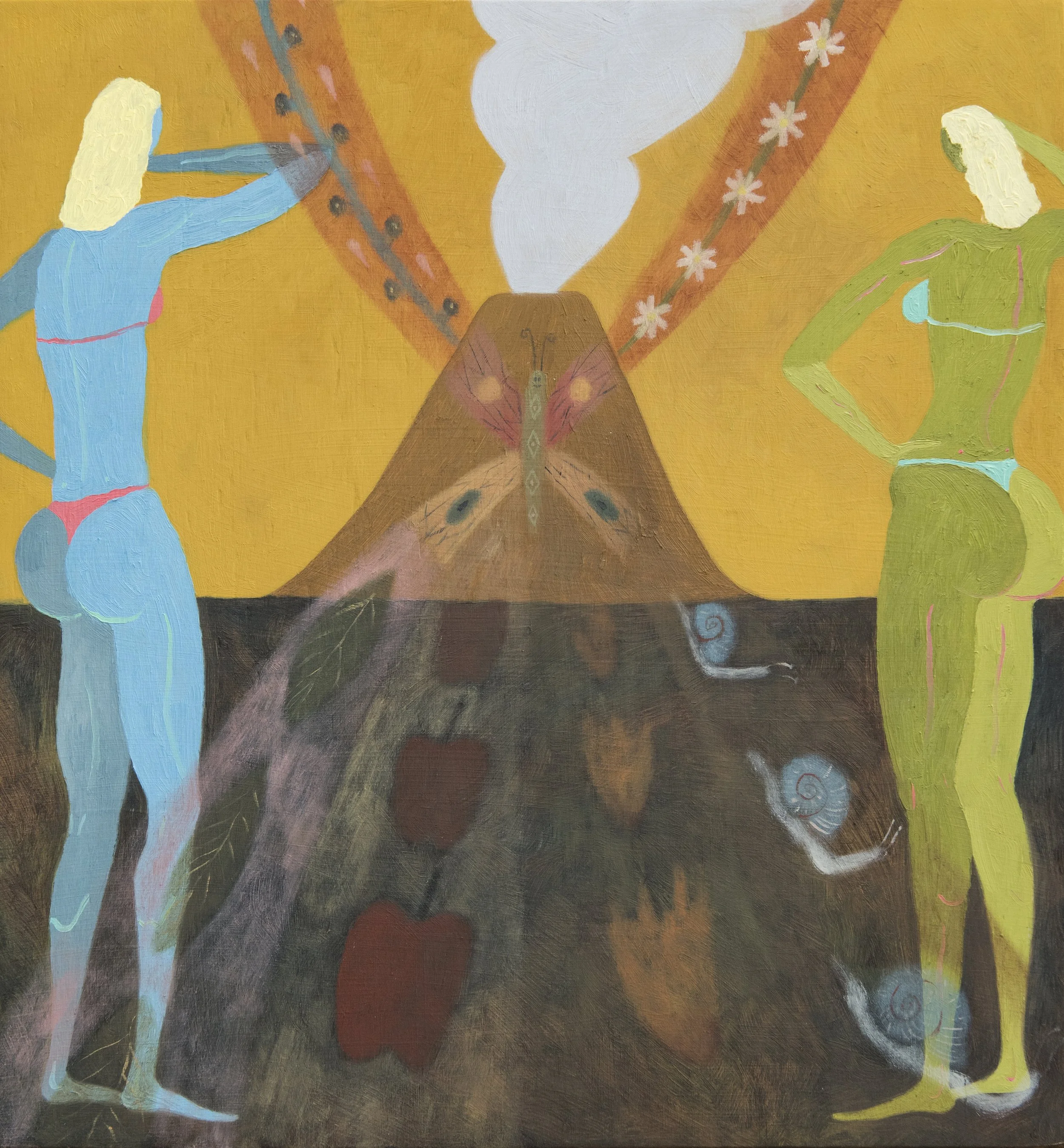
Robertson often speaks of her paintings as portals, as she also paints them into the works as small dark tears in the picture plane, sometimes trimmed with snowdrops. Picking up the story again in the work The girls encounter the Volcano of Becoming (2026), we learn more about this intention or mode. Here, our protagonists from YouTube Workout have encountered an erupting volcano. At first unsure of this horizon, a significant internal shift has occurred within them through the viewing. Binding patriarchal thorns begin to burn away and, amidst signs and symbols that help them on their way, the women are enabled to step into a continued state of becoming, of inner change and potentiality. The colour red is now present in greater way and beyond the bounds of its form, the apple, too, has become sacred.
In many ways, these works honour an understanding of human connectedness to the earth, through the myth of Eden, cued by all the imagery, and signified in places, perhaps, by the domestic – the spiritual comfort that can be found in the familiarity of the home/hearth and garden, for example.
A culmination painting, Memento Vivere (2026), includes many of the symbols already introduced and activated across the body of work. At the core of the image, the central characters are now fully clothed and freed from the patriarchy with a new understanding of what it means to live.
Invoked by the apple, one way of reading this series is a fresh interpretation of the myth of Adam and Eve in the garden – a text with a historically entrenched reception and harmful patriarchal consequences for women. Instead, in a feminist tradition of recovery and liberation, and through imagery drawn from esoteric traditions and direct experience, Robertson offers a personal rendering and reclamation of sacredness and potentiality.
- Joanna Osborne, 2026